


In this article
If your English draft is already grammatically correct and just sounds repetitive, a generic paraphrasing tool — QuillBot, Wordtune, or any of their competitors — will do the job in 2026. But if your writing carries Spanish structure into English — false cognates like actualmente turning into “actually,” reflexive se constructions becoming “it was decided that,” sentences running four clauses deep — a synonym-swapping paraphraser will polish the surface and leave the real problem intact. In that case you need a bilingual workflow: a tool that knows what Spanish interference looks like and shows the original and the rewrite side by side.
Here is the whole guide in one paragraph. Generic paraphrasers rewrite English into different English; they have no idea your draft started life in Spanish. A paraphrasing tool for Spanish speakers needs three things generic tools don’t have: false-cognate detection, restructuring of se-passive and impersonal constructions, and a bilingual view so you can verify the rewrite still says what you meant. Use a generic tool when your problem is variety or tone. Switch to a bilingual workflow when readers tell you your writing “sounds translated.”
What generic paraphrasing tools actually do
Let’s be fair to them first, because they are genuinely good at their job. A QuillBot- or Wordtune-class tool takes an English sentence and produces alternative English sentences: it substitutes synonyms, reorders clauses, adjusts tone from casual to formal, and shortens or expands. For a native speaker who wrote a correct but flat paragraph, this is exactly what’s needed, and the output quality in 2026 is high.
The limitation is structural, not a matter of quality. These tools are monolingual. They take English in and put English out, and they assume the input means what you intended it to mean. That assumption fails quietly for Spanish speakers.
Take this sentence, which contains a classic false cognate:
“I assisted to the conference last week.”
The writer meant asistí a la conferencia — “I attended the conference.” A generic paraphraser, working only from the English words on the page, might offer: “I provided assistance at the conference last week.” Now the sentence is grammatical, fluent, and confidently wrong. The tool didn’t make a mistake — it faithfully preserved a meaning error it had no way to detect, and made it harder to spot by making it sound better.
That is the core issue. Synonym swapping treats symptoms at the word level. Spanish interference lives one level down, in meaning and structure.
What Spanish speakers actually need from a paraphraser
False-cognate awareness
Spanish and English share thousands of Latin-rooted words, and a few dozen of them are traps. A Spanish-aware tool should flag these as meaning risks before rewording anything:
| You wrote | You probably meant | Because in Spanish… |
|---|---|---|
| actually | currently | actualmente = currently |
| assist | attend | asistir = to attend |
| realize | carry out | realizar = to carry out |
| career | degree, studies | carrera = university degree |
| compromise | commitment | compromiso = commitment |
| library | bookstore | librería = bookstore |
| eventually | possibly | eventualmente = possibly |
A monolingual paraphraser will happily rephrase “my compromise with the project” into “my concession to the project” — a different wrong meaning. A bilingual tool asks the more useful question: given a Spanish-speaking writer, is this word likely a cognate slip? We wrote up the broader pattern set in common English mistakes Spanish speakers make if you want the full list.
Fixing the se-passive and impersonal habit
Formal Spanish leans hard on impersonal constructions: se analizaron los datos, se considera que, se decidió posponer. Carried directly into English, these produce sentences that are technically parseable but read as translated:
Before: “It was performed an analysis of the customer data, and it is considered that the results are significant.”
After: “We analyzed the customer data and consider the results significant.”
Notice what changed: not vocabulary, but who is doing what. English strongly prefers a visible agent. A generic paraphraser will often keep the impersonal frame because, again, it preserves the structure you gave it. A Spanish-aware rewrite recognizes the se-passive fingerprint and restores an agent. (A quick self-check: search your last document for sentences that open with “It was” or “It is considered” — Spanish speakers are consistently surprised by how many they find.)
Splitting the clause chains
Written Spanish comfortably sustains 40-word sentences with three or four subordinate clauses. English readers start losing the thread around 25 words. The fix is not reshuffling the clauses — it’s splitting the sentence, deciding which idea is primary, and demoting or cutting the rest. That’s an editorial decision, and it’s one a bilingual tool can make more safely because it can check the split against your original intent rather than against its own guess.
A side-by-side bilingual view
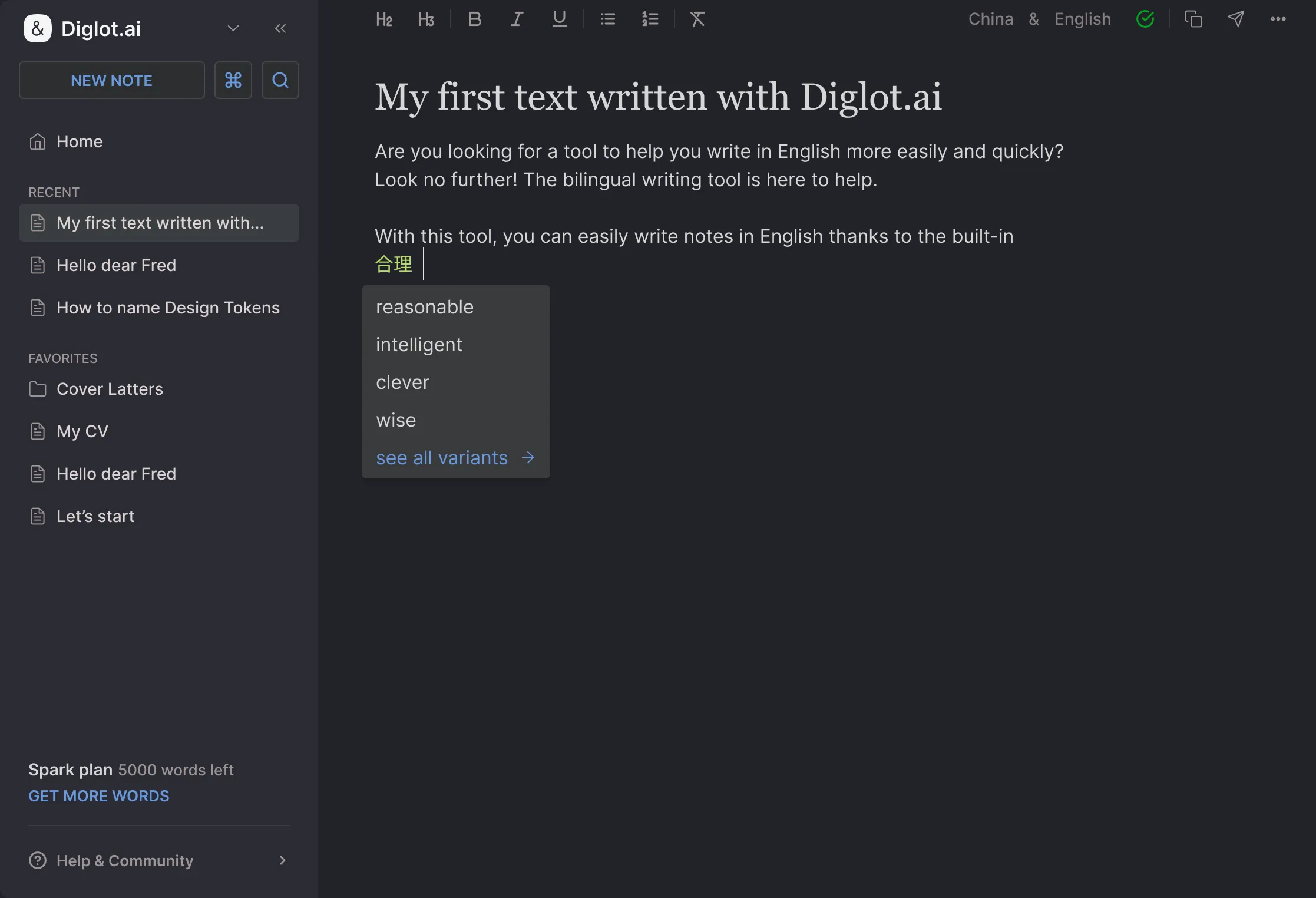
This one sounds like a convenience feature but it’s really a trust feature. When a tool rewrites your paragraph, the only person who can confirm the meaning survived is you — and you can confirm it fastest in your first language. I write English as a second language myself (my first language is Ukrainian, not Spanish, but the mechanics of interference are the same), and I still draft tricky paragraphs in Ukrainian before rebuilding them in English. Seeing both versions next to each other is how I catch the rewrites that drifted. Diglot’s editor is built around exactly this side-by-side check, because pasting between a translator tab and a paraphraser tab is where meaning quietly leaks out.
When a generic paraphrasing tool is enough
Honest answer: quite often. Reach for a QuillBot- or Wordtune-class tool when:
- Your English is already correct and you need variety, a tone shift, or a shorter version.
- The stakes are low — internal messages, social posts, first-pass blog drafts.
- You’re at C1 or above and interference errors are rare enough that you’ll catch them yourself on a read-through.
- The text is short enough that you can verify every sentence against your intent.
These tools are also faster for micro-edits — one awkward sentence, one repeated word. No bilingual machinery needed. If you’re weighing that class of tool specifically, we keep an up-to-date feature comparison at Diglot vs Wordtune — Wordtune is a well-made product, and for some writers it’s the right choice.
When you need a bilingual workflow instead
Switch when any of these are true:
- Readers say your writing “sounds translated.” That feedback almost never means vocabulary; it means structure — article use, sentence rhythm, impersonal constructions. We broke down the mechanics in why your English sounds translated.
- You draft mentally (or literally) in Spanish first. Then every paragraph is a translation, and a monolingual polish can’t see the source it needs to check against.
- The document is high-stakes — thesis chapter, journal submission, visa letter, job application. Here a fluent-but-wrong cognate isn’t a style problem; it’s a comprehension problem.
- The same corrections keep coming back. If a professor or editor has flagged “assist/attend” or “it was performed” more than once, the pattern is systematic and needs a tool that targets it.
The decision in one table
| Your situation | Use |
|---|---|
| Correct English, needs variety or tone change | Generic paraphraser |
| Short, low-stakes text you can self-verify | Generic paraphraser |
| Feedback says “sounds translated” | Bilingual workflow |
| You think in Spanish while drafting | Bilingual workflow |
| High-stakes academic or professional document | Bilingual workflow |
| Recurring cognate or se-passive corrections | Bilingual workflow |
How to test any paraphraser in five minutes
Don’t take my word for any of this — run the test yourself. Paste these three sentences into whatever tool you’re evaluating:
- “Actually I work in Madrid since 2019 and I have assisted to many international conferences.”
- “It was performed an analysis of the results, and it is considered that the method is valid.”
- One real 40-word sentence from your own last document.
A tool that serves Spanish speakers should: flag “actually” and “assisted” as probable cognate slips (not just reword them); fix “work… since” to “have worked… since”; rebuild sentence 2 around an agent (“We analyzed… and consider…”); and split sentence 3 rather than reshuffle it. If the output is fluent English that preserves your original errors in nicer clothing, you’ve learned what that tool is for — and it isn’t this.
If the bilingual column of that table describes you, that’s the exact case we built Diglot’s paraphrasing tool for Spanish speakers for: false-cognate flags, se-passive restructuring, and your Spanish and English side by side so you can verify every rewrite yourself. It’s free to try, and if a generic tool turns out to be all you need, the five-minute test above will tell you that too.
Share