


In this article
A lexical gap is a concept that a language has no single word for, even though the concept itself is perfectly ordinary and the language could easily have formed a word for it. Linguists also call it a lacuna. Russian has сутки (sutki) and Ukrainian has доба (doba), one everyday word for a period of twenty-four hours; English has to say “twenty-four hours” or “a day and a night”. German has Termin, Portuguese has saudade, Spanish has sobremesa. The concept is sayable in English — every concept is — but it is not packed into one word, and if you write in English as a second language, you feel that missing word several times a day.
English is my second language. I think in Russian and Ukrainian, and I write for work in English, which means the lexical gap is not an abstract linguistics topic for me. It is the small daily stumble where the sentence is moving, the exact word arrives instantly — in the wrong language — and English offers either a clumsy phrase or nothing at all. This article names that experience, sorts it into types, and ends with the practical question that actually matters: what do you do, mid-sentence, when the word you need does not exist in the language you are writing in?
What a lexical gap actually is
A lexical gap is not a hole in the world. It is a hole in the dictionary. The thing itself — the stretch of time, the feeling, the social situation — exists for English speakers exactly as it exists for everyone else. What is missing is lexicalisation: the packing of that concept into a single word that people actually use.
Linguists distinguish two situations. Inside one language, there are accidental gaps: word shapes the language would happily allow but nobody has coined. “Blick” is a famous invented example — a perfectly pronounceable English word that simply does not exist. Across languages, there is the gap bilinguals feel: language A has lexicalised a concept and language B has not, so speakers of B must reach for a phrase, or for several partial words, none of which fits exactly.
The second kind is the one that shapes your writing day. And the key point, worth holding onto for the rest of this article, is that the concept is almost always expressible. That is what makes a lexical gap frustrating rather than mystical. You are not trying to say the unsayable. You are trying to say something normal, and the language is making you pay three words for it.
The main types of gaps, with examples
Not all gaps feel the same. Here are the kinds I keep falling into, with examples from languages I know and languages whose famous gap-words have travelled widely.
| Word | Language | What it means | What English makes you say |
|---|---|---|---|
| сутки / доба | Russian / Ukrainian | a period of twenty-four hours, as one unit | ”twenty-four hours”, “a full day” |
| послезавтра / übermorgen | Russian / German | the day after tomorrow | a three-word phrase |
| Termin | German | a fixed, scheduled slot: appointment, date, deadline | different words for each situation |
| saudade | Portuguese | a tender, melancholic longing for something absent | ”nostalgia” (too weak, too past) |
| sobremesa | Spanish | the time spent lingering and talking after a meal | a whole clause |
| Kummerspeck | German | weight gained through comfort eating | a whole clause, minus the humour |
Precision gaps. English “day” is ambiguous: it can mean daylight hours or the full cycle. Сутки and доба are never ambiguous. When I write about server uptime or hospital shifts in English, I feel this one physically — the concept in my head is one crisp unit, and the sentence comes out flabby.
Compression gaps. English can obviously say “the day after tomorrow”; it just cannot say it in one word. Older English actually had “overmorrow”, but it fell out of use. These gaps cost you rhythm rather than meaning: the phrase works, but it lands with three syllables of padding in a sentence that wanted one word.
Culture-bound words. Saudade, sobremesa, Danish hygge. These grew out of habits and moods a culture noticed often enough to name. They are the celebrities of the “untranslatable words” listicles, but notice that they are not actually untranslatable — each one has a serviceable English gloss. What they lack is an English word.
Emotion words. Some feelings are named with more resolution in one language than another. Nabokov, annotating his translation of Pushkin, famously insisted that no single English word could render all the shades of toska — a Russian word covering everything from vague restlessness to deep spiritual ache. He then spent several sentences translating it anyway, which is rather the point.
Grammar-made words. Slavic languages build diminutives into almost anything: Ukrainian can turn tea into чайок, a word that carries warmth, smallness and affection at once. English can only stack adjectives around “tea” and hope. The gap here is not one missing word but a whole missing mechanism.
English has gaps too
It is worth saying clearly: this is not a deficiency of English, and the traffic is not one-way. Every language has gaps, including yours and including English — English speakers just rarely notice theirs until a bilingual points them out.
English has “widow”, “widower” and “orphan”, but no word for a parent who has lost a child — a gap so conspicuous that grief counsellors regularly remark on it. It has “disgruntled” without a commonly used “gruntled”, and “unkempt” without an everyday “kempt”. And when English notices a gap it cares about, it does what it has always done: it borrows. Schadenfreude, Zeitgeist, déjà vu, karaoke, and lately hygge itself — each of these is a patch over an English lexical gap, imported with the concept still attached. A language borrowing a word is a language admitting the gap was real.
Lexical gap is not the same as untranslatable
The phrase “untranslatable words” is good marketing and bad linguistics. If a word were truly untranslatable, the listicles could not exist, because they translate every word they feature — that is the whole format. What people mean by “untranslatable” is almost always “no single-word equivalent”, which is precisely the definition of a lexical gap.
The distinction matters practically. Untranslatability would be a wall; a lexical gap is a toll. You can always get your meaning across, but you pay for it in one of three currencies:
- Precision. You settle for the nearest existing word — “nostalgia” for saudade — and lose the shades that made you reach for the word in the first place.
- Rhythm and length. You paraphrase, and your sentence swells. Do this often and your prose turns heavy; it is one of the quiet reasons second-language writing can score poorly on a readability check even when the grammar is flawless.
- Naturalness. You translate the concept word-for-word from your first language, and produce something an English reader has never seen. Calques like this are a classic reason a text sounds translated even when every individual word is English.
Knowing which toll you are paying, and choosing it deliberately, is most of the craft here.
The other gap: the word exists, but you cannot reach it
There is a second experience that bilinguals fold into the same frustration, and it deserves its own name because the fix is different. Sometimes English does have the word — you have read it, you may even have used it — but at the moment of writing it will not come. Psychologists call the state “tip of the tongue”, and the general inability to retrieve a word has its own splendidly obscure name: lethologica.
Research on bilingual memory suggests that people who use two languages hit tip-of-the-tongue states somewhat more often than monolinguals, and the everyday experience matches: your first-language word arrives instantly and loudly, and it sits on top of the English word you are trying to excavate. This is not your English failing. It is two lexicons activating in parallel, with the stronger one winning the race. Strictly speaking this is a retrieval gap, not a lexical gap — but at the keyboard, at 11 p.m., with a deadline, it feels identical: the sentence stops.
What a gap does to your draft
Here is the real cost, and it has little to do with linguistics. When you hit a gap mid-sentence, you have three habitual options, and all of them are bad:
- Stop and hunt. Open a dictionary tab, then a thesaurus tab, then a forum thread titled “is there an English word for…”. Five minutes later you have the word, or a shrug, and your sentence has gone cold. The tab-switch is the expensive part: writing momentum does not survive it well.
- Settle. Take the almost-right word and keep moving. Sometimes correct; done reflexively, it flattens your writing to the vocabulary you can retrieve under pressure, which for most second-language writers is far smaller than the vocabulary they actually know.
- Paraphrase on the fly. Safe, but this is how one crisp thought becomes a nineteen-word sentence, and how доба becomes “a period of one day and the following night”.
Every option makes you choose between the word and the flow. That is a false choice, and it is a workflow problem, not a language problem.
The workflow answer: do not stop — write the word you have
The fix that changed my own writing is embarrassingly simple: when the English word is missing or will not surface, type the word you do have — in Russian, Ukrainian, whatever your first language is — and keep the sentence moving. “The monitoring window covers one full сутки” is a perfectly good draft sentence. The thought is captured at full resolution; the translation becomes a separate, later, smaller problem.
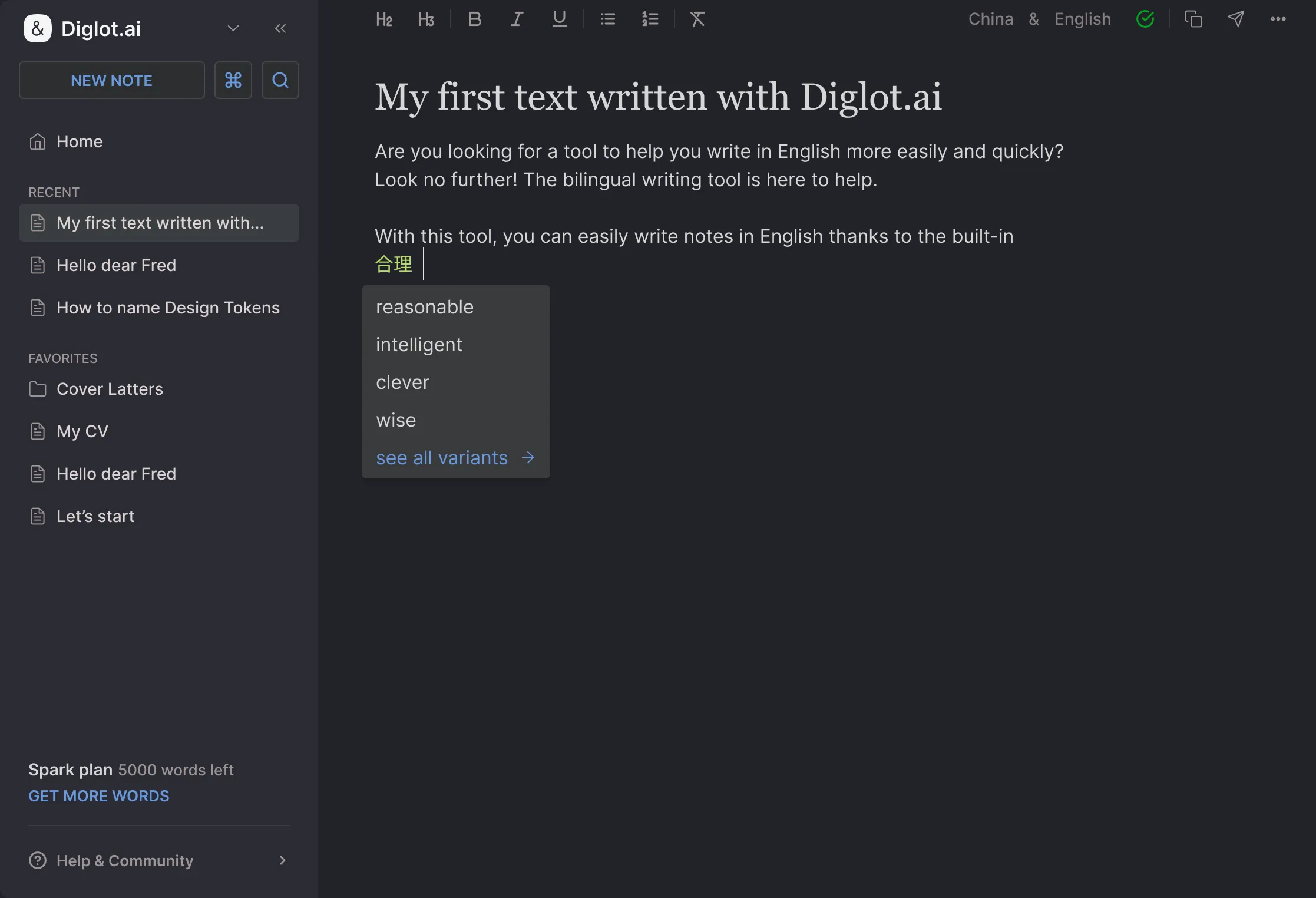
This is exactly what Weave was built for. You write the mixed sentence, and the first-language word is translated inline, in place, using the whole sentence as context — which is what a gap-word needs, because сутки in a sentence about hospital shifts and сутки in a sentence about server uptime want different English renderings, and Termin needs “appointment” in one sentence and “slot” or “deadline” in another. A dictionary gives you the word alone; context is the only thing that resolves a lexical gap well, and by the time you have finished the paragraph, the gap has been filled without the sentence ever going cold.
I will not pretend this makes the gaps disappear. Saudade still has no English word, and neither does доба; some tolls always get paid. But there is a real difference between paying them mid-sentence, with your momentum as the currency, and paying them at review time, with a translation that saw your whole sentence. Your first language is not interference to be suppressed while you write English. It is where half of your precision lives — and the entire premise of a bilingual writing workspace is that you should get to use it.
Share