


In this article
If your major was one of the roughly 12,200 undergraduate programs Chinese universities cut between 2021 and 2025 (Ministry of Education data reported via Xinhua; covered by Bloomberg and Forbes in June 2026), here is how to handle it in a statement of purpose: name the change in one neutral, factual sentence, then spend the rest of the paragraph on what you did about it. Admissions committees do not hold institutional decisions against applicants. They hold confused, defensive, or evasive writing against applicants.
The working structure needs three moves, not three paragraphs: (1) one sentence stating the fact — “My university discontinued its Public Administration major in my second year; I completed my degree under the merged Management Science track”; (2) two or three sentences showing agency — the courses, projects, or independent work you used to keep your original direction alive; (3) one bridge sentence connecting that adaptation to the program you are applying to now. Everything below is about executing those three moves well — under the timeline pressure of a change that lands mid-cycle, and often in a second language.
Why thousands of applicants suddenly share this problem
Twelve thousand two hundred discontinued programs is not a trim — it is a redesign of the undergraduate landscape, with many of the closed majors replaced by AI-focused degrees or folded into merged interdisciplinary tracks. For anyone applying abroad for a master’s or PhD, this creates three concrete problems:
- Your transcript may not match your story. You enrolled in one major and graduated from a track with a different name, or with courses split across two department codes.
- Your program may no longer exist online. An admissions reviewer who searches your university’s site for your major might find nothing — or find a page announcing its closure.
- Your recommenders may describe a program that isn’t on your diploma. A professor writing “she was one of the strongest students in our Applied Linguistics program” creates friction if your degree certificate says something else.
The one piece of genuinely good news: you are not an anomaly, you are a cohort. At this scale, any admissions office that reads applications from China is seeing the same pattern over and over. Reviewers are not startled by a discontinued major. They are only startled by applicants who cannot explain it cleanly.
How to explain a discontinued program in your SOP: the one-sentence rule
The most common mistake in drafts about disrupted degrees is proportion. The program closure takes over the essay — half a page of institutional history, restructuring committees, and apology. The reviewer learns a lot about your university’s administration and almost nothing about you.
Compare the two versions:
Weak (defensive, 70+ words):
Unfortunately, due to circumstances beyond my control, my university made the difficult decision to discontinue the program I had carefully chosen, which caused significant disruption to my academic plans and forced me to adapt to a completely new curriculum that I had not anticipated, although I tried my best to maintain my grades despite these challenges.
Strong (factual, 58 words, mostly about the applicant):
In my second year, my university discontinued its International Trade major and merged it into a Digital Economy track. I kept my original focus by taking the remaining trade-policy electives, completing an exchange-economics thesis under my original supervisor, and auditing the WTO-law seminar the new track dropped. That combination — trade fundamentals plus mandatory data coursework — is exactly what draws me to your program.
Notice what the strong version does. The closure gets one clause. Every sentence after it contains a verb with the applicant as the subject: kept, took, completed, audited. The paragraph ends facing forward, at the target program.
Where it goes: in the academic-background paragraph — usually your second or third — never the opener. Your first paragraph should be about the question or problem that drives you, not an administrative event. Pure logistics (transcript naming, degree-title discrepancies) belong in the application’s additional-information field, which exists precisely so your essay doesn’t have to carry them.
Reframing a discontinued major as evidence of direction
Here is the reframe that changes the essay: a discontinued program is an accidental test of whether your interest survives without institutional support. Most applicants can only claim commitment; you can demonstrate it. If your major disappeared and you kept doing the work anyway — cross-department electives, an independent project, a thesis topic you defended inside a merged track — that is stronger evidence of direction than four undisturbed years would have been.
| Weak framing | Strong framing |
|---|---|
| ”My plans were destroyed by the closure" | "The closure forced me to define my focus precisely enough to rebuild it from electives" |
| "I had no choice but to switch tracks" | "I chose which parts of my original program to carry into the new one" |
| "Despite the disruption, I maintained my GPA" | "The merged track added mandatory statistics and programming — coursework I now use in my research proposal" |
| "The new AI-focused degree was not what I wanted" | "The replacement track gave me methods training my original major never offered; my interests stayed the same, my toolkit grew” |
One honest caveat about the last row. Many cut programs were replaced with AI-flavored degrees, and it is tempting to claim “interdisciplinary background” as a free upgrade. Only do it with specifics — name the course, the tool, the project. A vague claim of AI exposure reads as padding; “I trained a text classifier on customs-declaration data for my trade thesis” reads as a fact.
Handling the timeline when the change lands mid-cycle
A program closure announced in September, when your applications are due in December, is a documentation problem before it is a writing problem. Work the checklist in this order:
| When | Do |
|---|---|
| Immediately | Save official evidence: the closure or merger notice, old program page (archive it), course descriptions in English |
| Week 1 | Confirm exactly what your transcript and degree certificate will say — the printed names, not what your department says informally |
| Week 1–2 | Brief every recommender in writing: one short paragraph explaining the change and the phrasing you use in your SOP, so all documents tell one story |
| Week 2 | Re-check the target program’s prerequisites against your actual completed courses, not your major’s label — a merged track sometimes silently satisfies more requirements than the old major did |
| Before submitting | Put logistics (name changes, transcript notes) in the additional-information field; keep the SOP narrative |
Two details applicants consistently miss. First, the recommender briefing matters more than the essay tweak — a mismatched letter creates doubt no paragraph can repair. Second, if the change happens after you submit, most graduate offices accept a short factual update by email. Three sentences, same structure as the SOP paragraph: what changed, what you did, what stays the same about your candidacy.
Writing it calmly in your second language
There is a language layer to this that native English speakers never have to think about. The register you need — factual, unbothered, quietly confident — is one of the hardest to hit in a second language. Under stress, second-language writers reach for the most dramatic vocabulary they know: shattered, devastated, forced, robbed. In an SOP, that vocabulary works against you, because it hands the agency in your story to the university administration instead of keeping it with you.
I write English as a second language myself — Ukrainian first — and I still draft the highest-stakes paragraphs in Ukrainian before rebuilding them in English. Not because my English fails, but because separating what I mean from how to say it in English produces calmer sentences than trying to do both at once. If your essay about the program cut sounds more dramatic in English than the event felt in your own language, that is usually a translation artifact, not your real voice — the pattern I’ve described in why your English sounds translated.
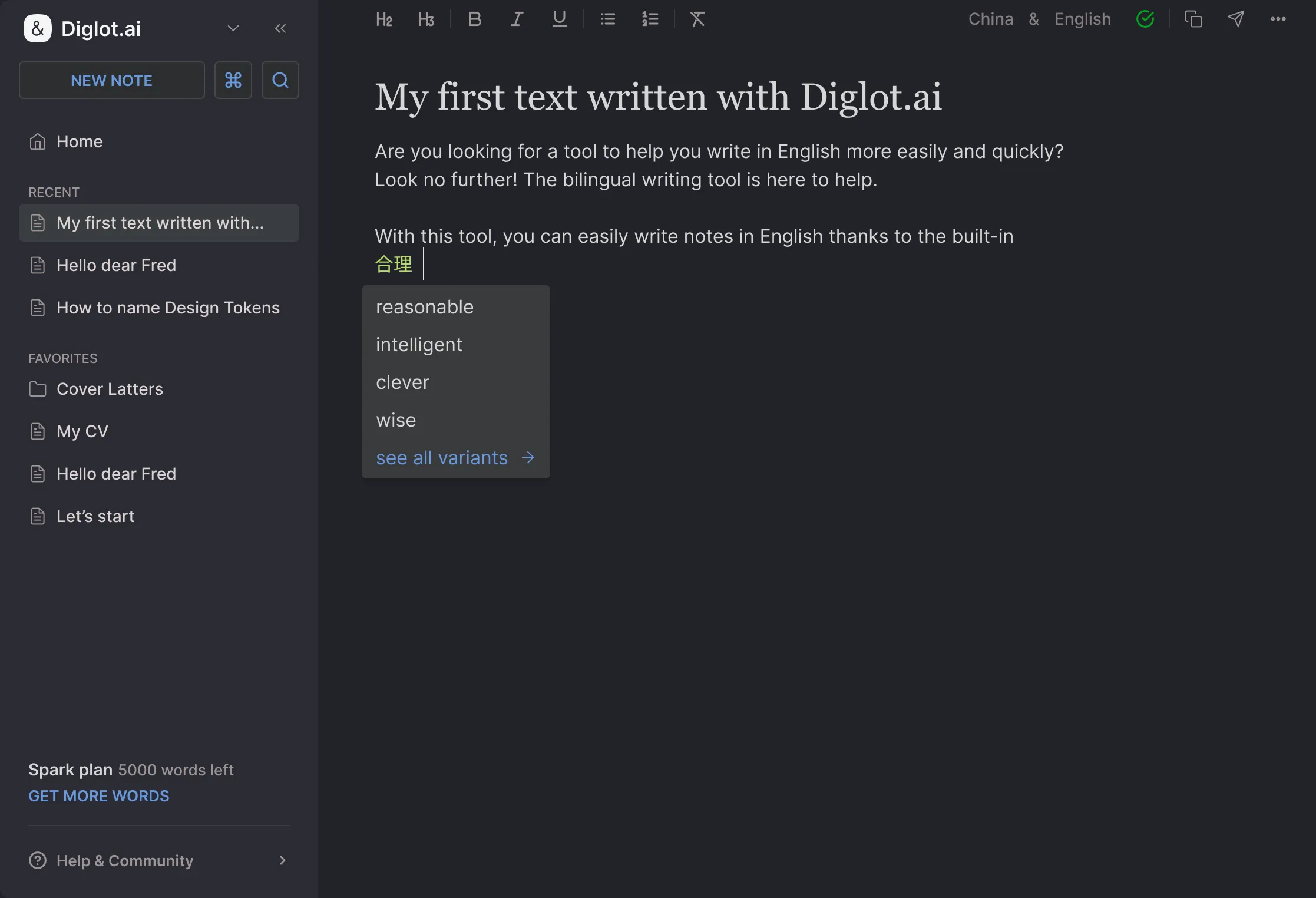
A practical calibration test: read your closure paragraph and count the emotional adjectives. More than one is too many. Then count the sentences where you are the grammatical subject doing something. Fewer than half is too few. A bilingual editor helps here precisely because it lets you check the meaning against your first language while tuning the English register — that is the workflow Diglot’s writing tool for students is built around.
Using AI help without creating a new problem
A last, uncomfortable note. Application essays are exactly the genre where students now fear being falsely flagged as AI-written — a fear common enough among non-native writers that we gave it a name: flagxiety. The discontinued-major paragraph is personal, specific, and verifiable, which makes it naturally resistant to that suspicion — generic AI drafts don’t contain the name of the seminar your merged track dropped. Keep it that way: use AI tools to tighten grammar and register, not to generate the story. If you want documented proof of your own writing process, an authorship certificate records how the text actually came into being — useful for exactly the high-stakes documents where doubt is most expensive.
If you are writing an SOP about a discontinued program right now, in English that is not your first language, this is the situation Diglot was built for: draft in the language where you think clearly, refine in the language the committee reads, and keep the calm, factual register the essay needs. Your program was cut. Your direction wasn’t — and the essay’s only job is to show that.
Share