


In this article
The words most associated with ChatGPT are: delve, tapestry, testament, moreover, foster, pivotal, realm, underscore, boast, meticulous, leverage, robust, seamless, landscape, navigate, harness, elevate, comprehensive, crucial, and multifaceted. Avoiding them can make your text read less like a template — but it will not make AI-sounding writing sound human, because detectors and readers respond to rhythm and uniformity, not individual words. And there is a complication most lists skip entirely: many of these “AI words” are classic formal-register vocabulary that non-native English writers were taught decades before ChatGPT existed, which is exactly why word-based judgments misfire on them.
I want to be upfront about where this article is going. Yes, the list is below, and it is as complete as I can honestly make it. But if you stop at the list and just find-and-replace “delve” with “explore”, you will have done the writing equivalent of repainting a car with a broken engine. The second half of this article is about the engine.
The list: words ChatGPT genuinely overuses
Nobody has the model’s word counter, but the pattern is consistent enough across millions of outputs that certain words have become a running joke. Researchers tracking academic abstracts noticed sharp frequency spikes in specific words after 2023 — “delve” being the most famous example, appearing in published papers at rates far above its historical baseline. Here is the working list, grouped by what the words are doing:
The famous three:
- delve — the single most memed ChatGPT word (“let’s delve into…”)
- tapestry — “a rich tapestry of cultures/experiences/flavors”
- testament — “a testament to the power of…”
Connectors and transitions:
- moreover, furthermore, additionally
- consequently, thus, hence
- notably, importantly, significantly
- in conclusion, in summary, ultimately
Corporate-sounding verbs:
- foster, harness, leverage, utilize
- underscore, highlight, showcase
- navigate (as in “navigate the complexities of”)
- elevate, empower, streamline, facilitate
- boast (“the city boasts a vibrant food scene”)
- embark (“embark on a journey”)
Inflated adjectives:
- pivotal, crucial, vital, paramount
- robust, comprehensive, holistic, multifaceted
- seamless, dynamic, innovative, cutting-edge
- meticulous, intricate, nuanced
- vibrant, bustling (every city ChatGPT describes is bustling)
Abstract nouns and frames:
- realm (“in the realm of…”)
- landscape (“the ever-evolving landscape of…”)
- journey (“your learning journey”)
- synergy, paradigm, framework
- “it’s important to note that…”
- “in today’s fast-paced world…”
If your draft leans on several of these at once — a robust framework that underscores a pivotal shift in the ever-evolving landscape — readers who have marinated in AI output for three years will feel it immediately. That instinct is real, and trimming these words is genuinely useful editing. The problem starts when the list gets used as a detector.
The part the listicles skip: these were ESL words first
English is my second language. When I learned academic English, “moreover” was not an AI tell — it was a vocabulary item on a test. Textbooks for academic writing across Eastern Europe, Asia, the Middle East and Africa have taught “moreover”, “furthermore”, “consequently” and “thus” as the correct connectors for formal register for generations. Learners drilled them in essay templates. Teachers rewarded them. IELTS and TOEFL preparation courses still coach linking words as a path to a higher score.
“Delve” is the sharpest example. In Nigerian English, a fully established variety in Africa’s most populous country, “delve” is ordinary, unremarkable vocabulary, used in newspapers and everyday formal writing. When the “delve = ChatGPT” meme took off, Nigerian writers pointed out, reasonably, that a word their entire country uses naturally had just been declared machine evidence. The same applies to Indian English, where formal-register words that sound stilted to an American ear are simply standard.
There is a reason the overlap is not a coincidence. Large language models were trained on enormous amounts of formal published text — the same corpus of academic and institutional English that ESL education is built around. The model learned formal register from the same books the learners did. So when a detector, or a suspicious reader, treats formal-register vocabulary as a machine signature, they are flagging the exact writing style that millions of people were explicitly taught.
This is not a theoretical unfairness. A Stanford study (Liang et al., published in Patterns, 2023) found that AI detectors falsely flagged 61% of TOEFL essays written by non-native English speakers. The mechanism the researchers pointed to — more uniform structures, safer and more conventional word choice — is precisely the fingerprint of trained formal English. The fear this produces has a name among ESL writers: flagxiety, the constant low-grade dread of writing something that trips a detector even though every word is yours.
So before you purge your vocabulary: if you are a non-native writer and “moreover” is genuinely how you connect ideas, the word is not lying about you. The question is whether your text has the other properties that make writing read as machine-made — and those have little to do with any single word.
Why deleting the words does not work
Here is a simple test. Take a paragraph of pure ChatGPT output and manually replace every listed word: delve becomes dig into, tapestry becomes mix, moreover becomes also. Read the result. It still sounds like ChatGPT. Slightly cheaper ChatGPT, but unmistakably ChatGPT.
That is because the words were never the core signal. They are the visible symptom of deeper patterns:
Uniform sentence rhythm. AI-generated text tends to produce sentences of remarkably similar length and shape, one after another, each carrying roughly the same information load. Human writing lurches. Some sentences run long because the thought is complicated. Some are three words. AI output reads like a metronome; detection methods that measure perplexity and burstiness are essentially measuring this evenness, not scanning for “delve”.
Symmetric structure. ChatGPT loves triads (“clear, concise, and compelling”), balanced clauses (“not only X, but also Y”), and paragraphs that open with a topic sentence, deliver exactly three supporting points, and close with a mini-summary. Every paragraph. It is the structure of a well-behaved school essay, executed with inhuman consistency.
Frictionless generality. AI text is smooth because it commits to nothing. It gestures at “various factors” and “numerous studies” without naming one. It hedges symmetrically (“while X has benefits, it also poses challenges”). A human writer who actually knows the subject cannot help leaking specifics — a date, a name, a number, an opinion that could be wrong.
No stakes. Nothing in the text costs the writer anything. There is no sentence where you feel the author risked being disagreed with.
Swap the vocabulary and all four properties survive untouched. This is why cargo-cult word avoidance fails: it imitates the surface of human writing without the mechanism. Worse, if you contort your text to dodge a word list — replacing natural words with awkward synonyms — you drift toward the “tortured phrases” territory that Cabanac and colleagues documented in academic publishing in 2021, where thesaurus-driven rewriting produced absurdities like “counterfeit consciousness” in place of “artificial intelligence”. Mechanical word substitution does not make text more human. It makes it strange in a new way.
What actually makes text sound human
If the signal is rhythm and specificity, that is what you edit for. Concretely:
Vary sentence length on purpose. After a long sentence, write a short one. Let one paragraph carry a single two-line thought while the next runs eight lines. If you read your draft aloud and it sounds like a steady march, break the step. Our readability checker shows sentence-length distribution, which makes the metronome visible — uniformity you cannot see in the wall of text jumps out in the numbers.
Add details only you could add. The strongest anti-AI signal is information that was not in anyone’s training data: your data, your example from last Tuesday, the specific thing your professor said, the number from your own experiment. Every concrete, checkable detail is a sentence no model would have produced.
Keep an opinion in the text. Commit to a claim. “This method is slower and I would not use it for anything over a thousand records” sounds human precisely because it is falsifiable. Symmetric hedging is machine music.
Cut the ceremony, keep your register. There is a difference between deleting empty ceremony (“In today’s fast-paced world, it is important to note that…”) and deleting your natural formal register. The first is good editing for everyone. The second is self-erasure — and for ESL writers it means performing a casualness that is not yours. If you write formally because that is how you write English, keep it, and put your humanity into rhythm and detail instead.
Watch the passive pile-up. Formal training plus AI polish often stacks passive constructions until no sentence has an actor. Find the places where the agents disappeared; restoring a few of them (“we measured” instead of “measurements were conducted”) does more for naturalness than any vocabulary swap.
And if you write across two languages, there is a second layer: phrasing that is grammatically correct but structurally translated from your first language. That is a different problem from AI-sounding text, though it often gets confused with it. Those sentences carry the skeleton of another language under correct English, and they need their own kind of edit, not a word swap.
The tool question: polish without erasure
There is a category of tool whose entire pitch is the opposite of this article: paste your text, click a button, get output scrubbed of “AI words”. The result is usually text with no words from the famous list and no trace of the writer either — a third voice that belongs to neither you nor the model. If your goal is to sound like yourself, a tool that rewrites you wholesale is solving the wrong problem. (This is the difference between editing and vibe writing: accepting fluent output without owning what it says.)
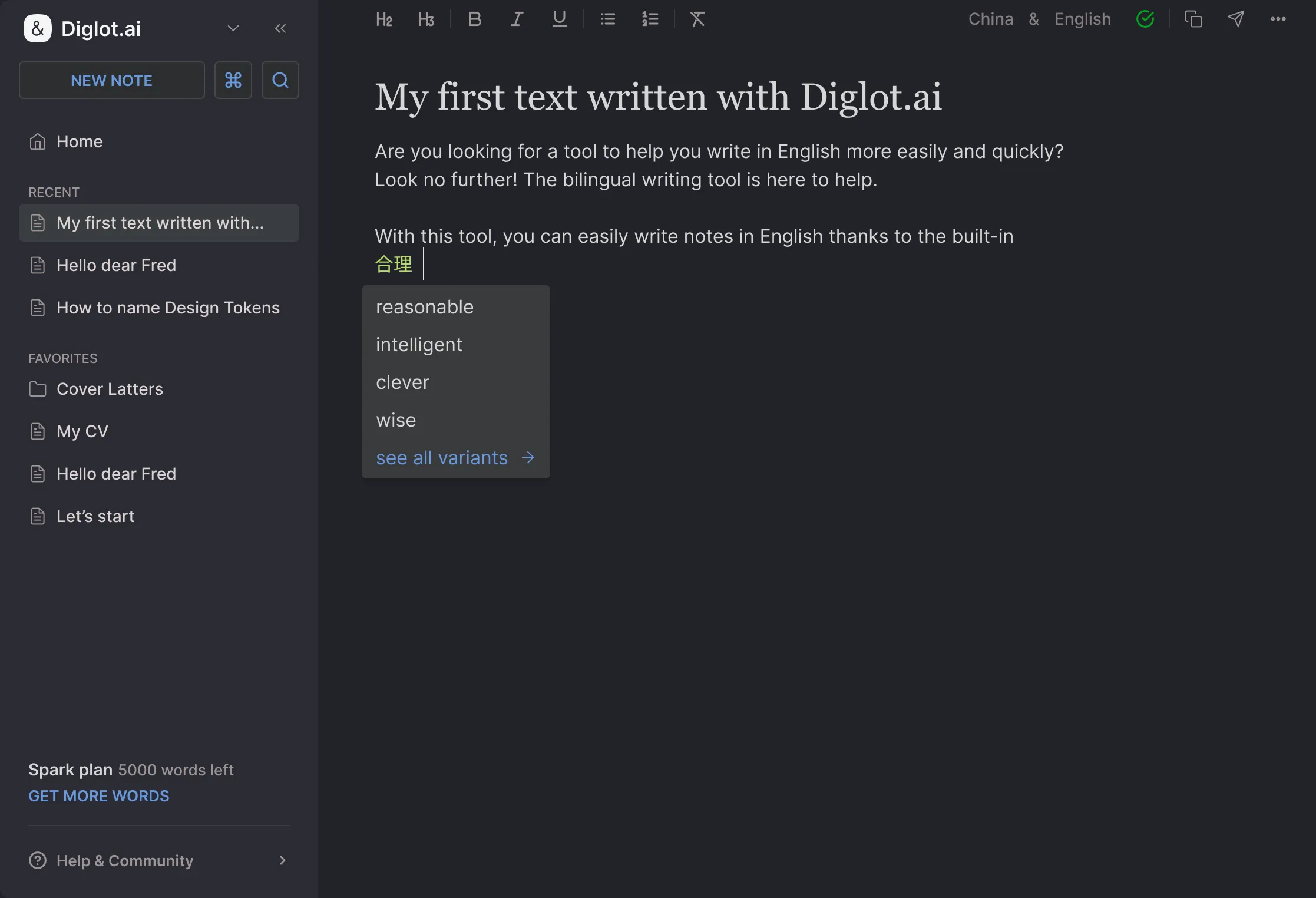
Diglot’s approach is deliberately narrower. The Weave editor works on your text at the level of suggestions you accept or reject one by one, so the rhythm and the choices stay yours. And because word lists and detectors will keep misfiring on formal, careful, second-language English no matter how well you edit, we also attack the problem from the evidence side: the editor can record your writing process as a signed, append-only event chain and produce an Authorship Certificate — so that if anyone ever asks whether the delves and moreovers are yours, the answer is not a vocabulary argument but a verifiable record. If that day comes with an actual accusation attached, we have a separate guide on what to do when a detector flags your human writing.
Use the list at the top of this page the way an editor would: as a prompt to ask, of each ceremonial word, “is this doing work, or is it filler?” Cut the filler. Keep the words that are genuinely yours — including the formal ones you learned the hard way. Then spend your real effort where the signal actually lives: sentences that vary, details that can be checked, and at least one claim you are willing to defend.
Share