

In this article
If your English drafts keep coming back with “this sounds off” — even when a grammar checker finds nothing to underline — the cause is usually one of five Arabic-to-English transfer patterns: dropped copulas (Arabic needs no “is” in a nominal sentence), verb-early ordering carried over from VSO, an extra “the” attached to abstract nouns the way al- attaches in Arabic, long comma-spliced chains built on wa- (“and”), and resumptive pronouns (“the article that I read it”). The fix is not more grammar drills. It is a workflow change: draft your argument in Arabic, where your thinking is strongest; translate sentence by sentence with the Arabic still visible; then run one deliberate revision pass that targets those five structures — patterns, not individual words.
That last distinction matters most. Most Arabic speakers edit English word by word, swapping vocabulary while the sentence’s skeleton stays Arabic. Reviewers don’t notice the words. They notice the skeleton. Below: the transfer patterns with before/after examples, the right-to-left friction nobody talks about, and a bilingual workflow that treats your Arabic as an asset instead of something to hide.
The five transfer patterns that make English drafts “sound off”
Arabic and English disagree at the level of sentence architecture, not just vocabulary. When you translate in your head, the architecture travels with you. These five patterns account for most of the “sounds translated” feedback Arabic speakers get:
| Arabic habit | What it produces in English | The fix |
|---|---|---|
| Nominal sentences need no copula (al-kitābu mufīd — “the book useful”) | “This method more accurate than the previous one.” | Add “is/are” in every equative sentence, especially long ones |
| Default VSO order (dhahaba al-walad — “went the boy”) | Delayed subjects, “There is/It is” openers stacking up | Put the grammatical subject in the first few words |
| al- attaches to abstract and generic nouns (al-ṣabr faḍīla — “the-patience [is a] virtue”) | “The unemployment is rising.” “The honesty matters in research.” | Strip “the” from abstract nouns used generically |
| wa- chains clauses indefinitely | Comma splices; four clauses joined by “and” | One idea per sentence; replace the second “and” with a period |
| Relative clauses keep a resumptive pronoun (alladhī qara’tuhu — “that I read-it”) | “The framework that we adopted it in Chapter 2” | Delete the pronoun; the relative word already fills that slot |
Two of these deserve a closer look because they are nearly invisible to the writer.
The copula gap hides in long sentences
Almost no Arabic speaker writes “The book useful” in a short sentence — you learned “is” in your first month of English. The copula drops out when the sentence gets long enough that your working memory reverts to Arabic structure: “The main limitation of this approach, especially when applied to low-resource settings with incomplete data, that it assumes stable input.” The “is” vanished twelve words in. Grammar checkers often miss this because the sentence is complex enough to confuse their parsing too.
The definite article works in both directions
Arabic has a definite article but no indefinite one, and al- covers generic statements that English leaves bare. So the transfer cuts both ways: “the” appears where English wants nothing (“the society expects…”), and “a/an” disappears where English requires it (“we propose new method”). If you fix only one direction, the text still reads as foreign — reviewers can rarely name why, but they feel it. For a fuller catalog with more examples, see our guide to common English mistakes Arabic speakers make.
The direction problem: what RTL drafting does to your editing
There’s a layer under the grammar that gets almost no attention: you compose in a right-to-left script and revise in a left-to-right one, often inside the same document. Anyone who has pasted an English citation into an Arabic paragraph knows the result — the cursor jumps, selections behave strangely, and the bidirectional text algorithm shuffles punctuation to places you didn’t put it. Arabic punctuation leaks into English drafts too: the Arabic comma (،) and question mark (؟) look close enough to their English cousins that they survive proofreading and then break formatting or reference managers downstream.
The deeper cost is attentional. Every switch between scripts is a small reorientation — reading direction, punctuation conventions, even where your eyes expect the beginning of a line to be. Mixing both languages in one document multiplies those switches. The practical fix is structural: keep Arabic and English in separate, parallel panes rather than interleaved in one file. You lose nothing — the Arabic stays visible — and the bidi chaos disappears.
A bilingual drafting workflow that keeps the Arabic visible
Here is the four-step workflow that consistently produces better English than “just write in English” — because it separates thinking from translating from de-transferring, instead of doing all three at once.
Step 1 — Draft the argument in Arabic. Fully. Not an outline: real paragraphs, with your actual claims and evidence. Don’t polish the Arabic; its only job is to hold your reasoning at full resolution. An argument drafted in your strongest language is simply a better argument.
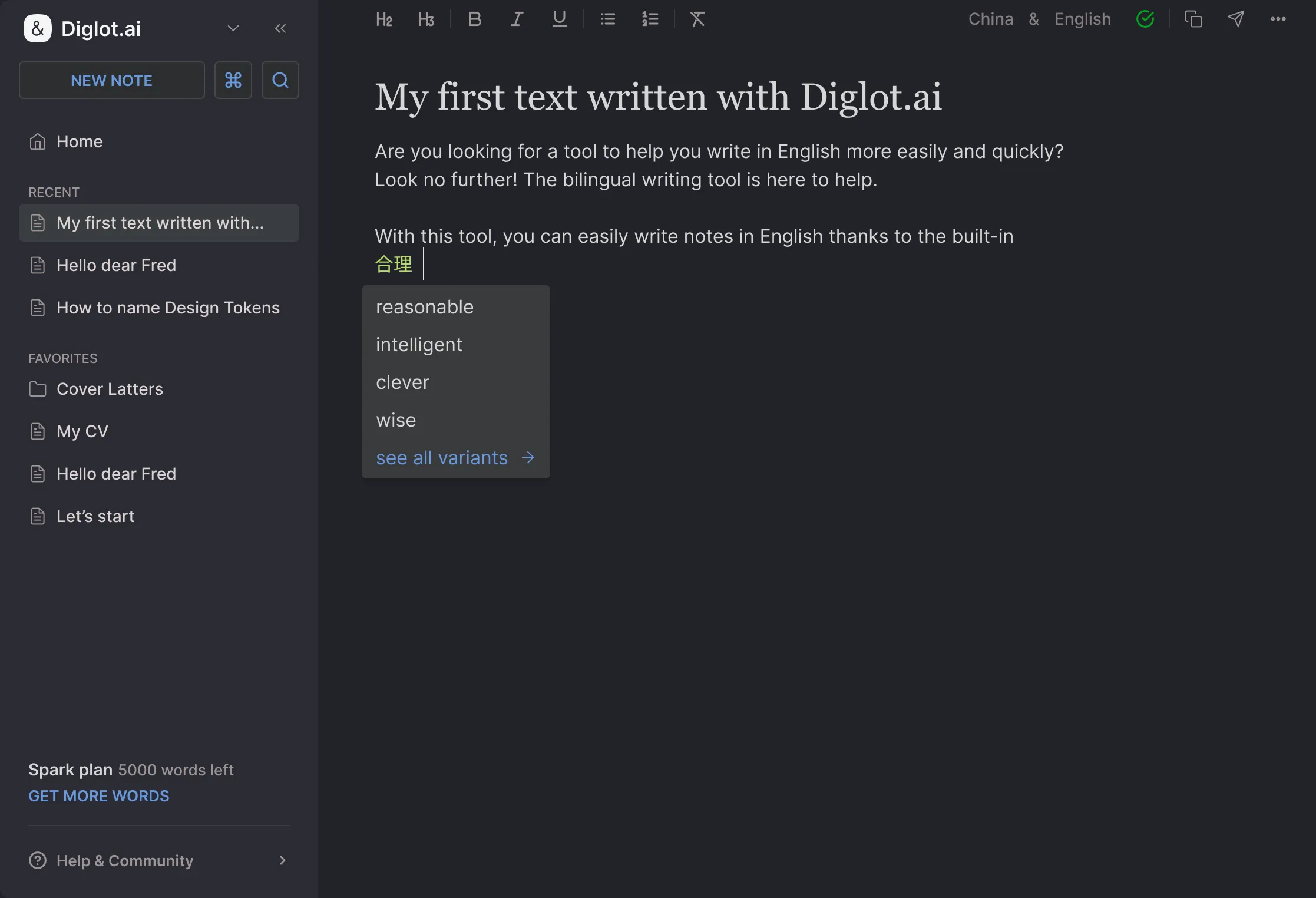
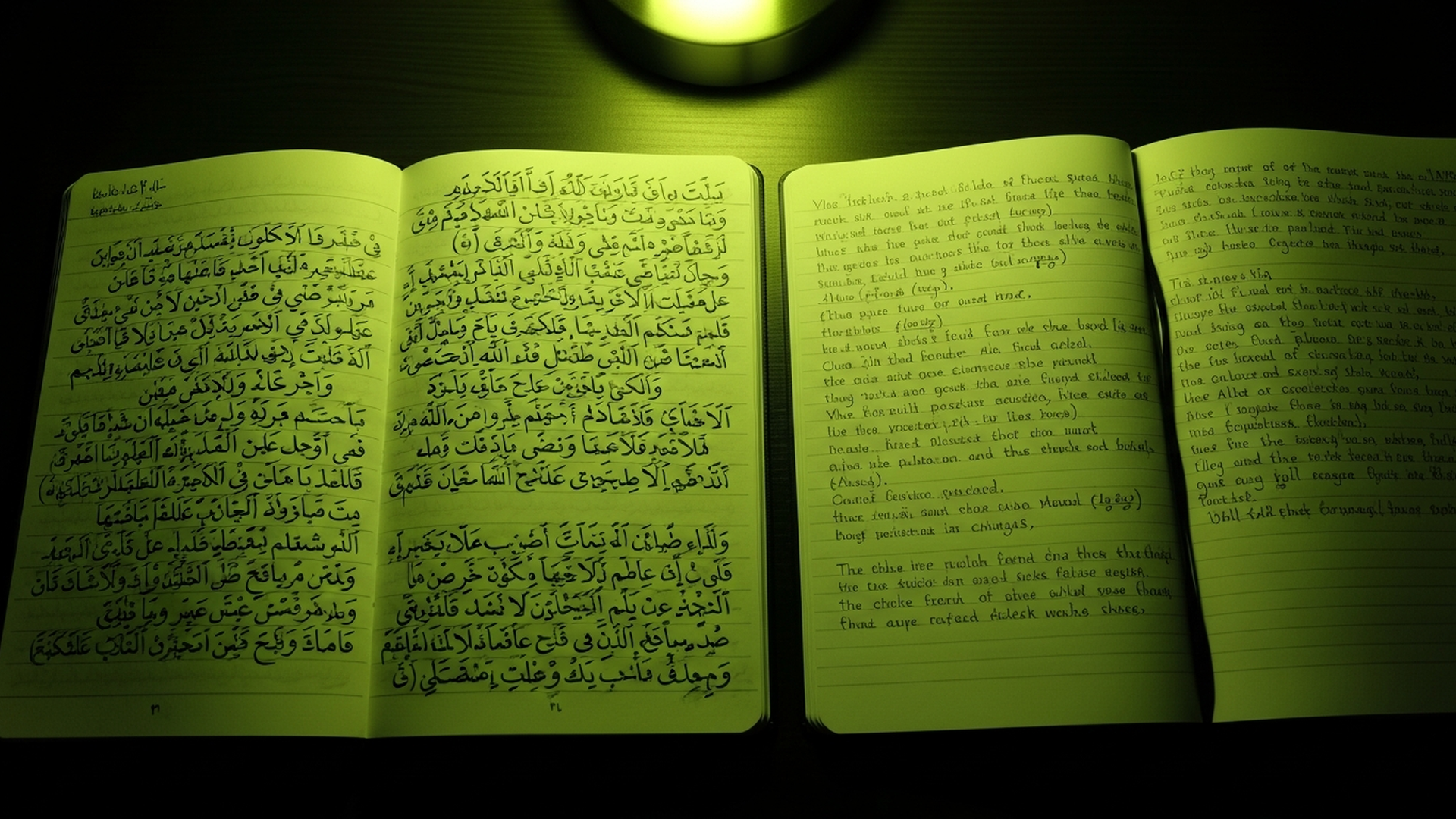
Step 2 — Translate sentence by sentence, side by side. Work through the Arabic one sentence at a time and write the English next to it — do not overwrite it. Keeping the source visible does two things: it stops you from silently dropping nuance (“this qualifier was hard to translate, so it vanished”), and it lets you check later whether the English still says what you meant. This is exactly the setup Diglot’s editor is built around — your language and English side by side in one document, so the original never disappears under the translation.
Step 3 — The pattern pass. Now read only the English, hunting the five skeletons from the table above: missing copulas in long sentences, delayed subjects, generic “the,” wa- chains, resumptive pronouns. This pass is mechanical and fast once you know what you’re looking for — you’re rewriting structures, not searching for better words. If the sentence still feels carried over from Arabic after the pattern pass, the techniques in how to rewrite translated text naturally go deeper.
Step 4 — The rhetoric pass. Arabic academic prose builds toward its claim through elaboration and parallelism; English academic prose front-loads the claim and then supports it. Move your topic sentences to the top of each paragraph, and cut one of every pair of parallel restatements. What reads as eloquence in Arabic reads as redundancy in English — this is a convention difference, not a quality difference.
Before and after: one paragraph, rewritten at the pattern level
Before (word-level editing done, skeleton still Arabic):
The unemployment is one of the biggest problems that the society faces it today, and the government tried many solutions, and the results were limited, and this because the root causes economic and also educational.
After (pattern pass applied):
Unemployment is one of the biggest problems society faces today. The government has tried many solutions with limited results, because the root causes are both economic and educational.
Five fixes, all structural: generic “the” removed twice, the resumptive “it” deleted, the wa- chain cut into two sentences, and the missing “are” restored before “economic.” Not one content word changed — and the second version no longer reads as translated. If reviewers keep telling you your writing “sounds translated” without pointing at anything specific, this skeleton-level rewriting is almost always what they’re missing the words for; we’ve written about why your English sounds translated in more depth.
Why “just think in English” is the wrong advice
The standard advice — stop translating, think directly in English — quietly assumes your English is already strong enough to think in. For most people it isn’t, and the result is arguments flattened to fit the syntax you can produce fluently. You end up writing simpler claims, not clearer ones.
I write English as a second language myself — Ukrainian first — and I still draft tricky paragraphs in Ukrainian before rebuilding them in English. My transfer patterns are different (Ukrainian speakers famously drop articles; Arabic speakers add them), but the workflow is identical: think at full strength in the first language, then translate deliberately, then remove the skeleton of the source language in a separate pass. Drafting in your L1 isn’t a crutch to outgrow. It’s how you keep the quality of your reasoning while your English catches up.
What an Arabic paraphrasing tool should actually do
Generic paraphrasing tools rewrite English into different English — synonyms shuffled, structure untouched. That fails Arabic speakers precisely because the problem is the structure: a synonym swap will happily preserve your resumptive pronoun and your comma splice while replacing “big” with “substantial.” A useful paraphrasing tool for Arabic speakers has to work pattern-aware: recognize the copula gap, the al- transfer, the wa- chains, and rewrite the skeleton while keeping your meaning — ideally with your Arabic still visible next to the result so you can verify nothing was lost in the rewrite.
That is the workflow Diglot is built for: draft in Arabic, translate side by side, and paraphrase at the pattern level without losing sight of what you originally meant. If you write in English but think in Arabic, try it on your next draft — start with one paragraph, keep the Arabic in the left pane, and see how much of the “sounds off” feedback disappears when you stop editing words and start editing skeletons.
Share